When the System Stays Silent, Bullies Sound Off

Author: Ivan Kuzmanovski
Modern ways of communication, the internet and social media have changed the way the media work, but at the same time they have changed the way threats reach journalists. Nowadays, all it takes to get a message across, with any content, is a few clicks on the mobile phone.
Institutional statistics and the reports of international organizations show whether journalists have adequate working conditions.
In the 2023 World Press Freedom Index of “Reporters Without Borders”, North Macedonia was ranked 38th on a global scale, but with the worst score on the security indicator. The report also points to the problems that journalists face in North Macedonia.
- Journalists are regularly the targets of verbal attacks. Under the pretext of protecting state secrets and personal data, they may be exposed to legal pressure and abusive prosecution (gag proceedings or SLAPPs), the 2023 report states in the section dedicated to safety.
The statistics of the Ministry of Interior (MoI) also confirm that there is plenty of room for improvement, especially in the area of threats received online. In 2019, 2020 and 2021 there were a total of 23 reports, while only in the first ten months of 2023 the police received ten reports of threats against journalists, or one case per month.
- During 2023, the MoI has received 10 reports related to threats of attacks on journalists/media workers and online messages with offensive content sent to journalists.
The MoI has informed the Basic Public Prosecutor ‘s Office about the reports and, having received guidelines from the BPPO, appropriate measures have been taken, as was said in the short answer from the Public Relations Unit of the MoI.
MoI’s figures do not match the data we received from the public prosecutor’s office. The PPO said that they have only six cases related to journalists this year.
- Out of a total of 6 cases related to the safety of journalists, registered by the public prosecutor’s offices, on the territory of the whole country, since the beginning of the year, there is already an issued verdict for 2 cases. An indictment has been made for two more cases (in one of which a verdict is expected based on a guilty plea made at the first hearing). This means that four cases from the point of view of the prosecution have been resolved with an appropriate decision. In the remaining 2, action has also been taken and specific guidelines have been given to detect the perpetrator of a crime, the PPO said.
The prosecutor’s office points out that in half of the cases (3 out of 6) the victims are women journalists.
- Physical attack against a television crew of Alsat TV in the Old Bazaar of Skopje (among the injured is a woman journalist) – an indictment has been made.
2. Threats against a woman journalist of Alsat TV made on the social networking service Twitter – instructions given to the MoI for the detection of the perpetrator of the crime through the appropriate channels for obtaining data from the social networking service.
3. Online hate speech with posts on a web portal in which, among others, 2 women journalists are targeted – a verdict was pronounced.
Of this total of six cases in 2023, four have been processed as online threats (threats made via electronic communication), i.e., one is a threat made via telephone and the other three are made via the internet and social media; while in two cases, as pointed out by PPO, a verdict has already been issued, and the identity of the perpetrator is being investigated in the other two.
A large number of women journalists are faced with offensive, threatening, and often sexist messages over the Internet, even though they do not report it. A simple survey in the newsroom showed that two out of three questioned women journalists regularly receive sexist messages and threats. However, they are aware that if they keep silent, the online threat might become an offline attack.
- As women journalists, we are constantly exposed to this kind of messages, insults and inappropriate comments. At the same time, our work takes us out in the public every day, in direct communication with the people, so there is always the possibility of coming across the people who send such messages on the street and one can never be sure how they will react. That is why it is necessary to speak out about what women journalists are subjected to while reporting, says journalist Ivana Sokolovic Najdova.
Journalist Ivana Sokolovic Najdova, who has been working for many years on internal political topics and relations with neighbours as well as European integration, is often appalled by such messages in her DMs on social media.
- It is not at all pleasant to receive messages from persons you do not know at all, who do not hesitate to send you sexist messages, at the same time telling you what they would do if they saw you in person. Fortunately, nothing has happened so far, but honestly, I have been scared many times thinking who I might run into while on a work assignment, Ivana said and she also pointed out that she has not yet filed a report with the competent institutions.
- I have not reported them to the authorities because I read my DMs on social media quite late, sometimes several months after they’ve been sent. And the lack of trust in the authorities, i.e., not believing that they will act accordingly has its fair share in the decision making. In addition, such sexist messages often come from fake profiles, but they are reported to Facebook as suspicious profiles, Ivana adds.
There are also women journalists who immediately reported the threats to the Ministry of Interior, but even after several years there are no results from it. Tanja Milevska, who was a correspondent for several Macedonian media outlets from Brussels for many years, testifies about what happened to her on social media, although she no longer works as a journalist and she also spoke about her experience with the institutions. She said that she was in a situation where she was afraid to take a look at her phone because of what she could read, and all of this affected her work and the way she reported, i.e., it led to self-censorship.
- There have been three waves of threats via social media. The first related to the 2020 elections by party sympathizers of VMRO-DPMNE and The Left (Levica), followed by a wave of threats from the gaming community and another wave around the admittance of refugees from Afghanistan. The messages were really horrid and in all these cases I filed reports with the MoI. Two years ago, I also went to the Cyber Unit, where the inspector informed me that everything was submitted to the prosecutor’s office. The MoI has done its job, says Milevska, who doubts that the prosecutor’s office is the one that puts the cases on the back burner.
The prosecutor’s office claims that the problem of threats on social media is a challenge in their work because they have to use tools for international cooperation and the person making the threats who most often sends messages from a fake profile should be identified by the company that owns the social networking service where the account, i.e., the user is.
- In a certain number of criminal cases, especially when the crime was committed via the Internet and social media registered abroad, the identification of the perpetrators is a challenge. In such cases, investigative authorities are obligated to use the channels for international cooperation, they are limited by the norms of the national legislation of the countries in which those social media are registered and which have their own rules for the protection of freedom of speech, as well as by the short period in which data necessary for identification are stored. For those reasons, the most important thing is the speed of reporting such crimes in order to provide the evidence in a timely manner, the public prosecutor’s office say.
The institutions are obligated to take actions on every report, but without a quick reaction they don’t have many opportunities, time goes only in favour of those who make the threats who can delete their social media account just as easily as they sent the messages, which is why there is a call to report the threats immediately.
The problems that women journalists are mainly facing in our country and which often force them to be “super women” is a problem that women journalists in the countries of the region are also facing. This is confirmed by the research of the Centre for Investigative Journalism from neighbouring Serbia, which refers to the conditions in which women investigative journalists work in Serbia, Montenegro and North Macedonia work. The conclusions of this research point to the problem of recognizing this type of violence as such.
- The various forms of violence against women in society (comments on appearance and private life, intrusive courtship, inappropriate showing of attention etc.) are often so normalized that they are not even recognized as violence, the conclusion states.
The research also showed the clear differences in the messages that women journalists receive online, that is, on social media, in contrast to the messages that their male colleagues receive.
- While men are exposed to negative remarks about their work, the work of women journalists is generally not commented on, instead, the emphasis is placed on their sexual attractiveness and assessments of the extent to which they are “real women”, which sends the message that a woman’s place is not in the public sphere and, indirectly, that their work is a consequence of some sort of “deficiencies” they have as women. In that sense, sexual harassment, sexist comments and insults appear as a sanction for overstepping the female gender role and are shaped in the legitimization of the wider socio -cultural context of patriarchal dominance, as is stated in the conclusions of this research.
Ivana Sokolovic Najdova also confirms that the big picture that is represented in society largely affects the problem.
- There must be an end to the practice of normalizing such messages and insults as if they are an expected part of our work. When the institutions put in more effort in reacting to complaints about sexism, the level of trust will increase and they will be reported more often, Ivana Sokolovic Najdova says.
Such insults and threats are often part of orchestrated campaigns aimed at silencing women journalists, causing self-censorship, removing them from social media, and oftentimes they are the reason for women journalists leaving the profession.
In order to help women journalists to be safer online, in March of this year, AJM and the MoI prepared a “Protocol for the Safety of Women Journalists Online” that offers practical advice on how to act when they are the subject of online threats. This protocol explains in steps and in detail the procedure that victims of online threats and insults should follow.
Women journalists are always at the forefront when citizens’ rights are violated, when it is necessary to help someone or to protect national interests. It is time for the system to show how important their rights are and to encourage them to speak up about them and not stay silent about insults and threats, so that there is someone to defend and protect the rights of everyone else.
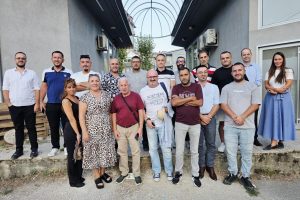
Photo: Ivan Kuzmanovski
This article was prepared within the project "Strategic Lawsuits Against Public Participation (SLAPPs) are a slap in the face to citizens and the public interest", supported by UNESCO. The designations employed and the presentation of material throughout this article do not imply the expression of any opinion whatsoever on the part of UNESCO concerning the legal status of any country, territory, city or area or its authorities, or concerning the delimitation of its frontiers or boundaries. The authors are responsible for the choice and the presentation of the facts contained in this article and for the opinions expressed therein, which are not necessarily those of UNESCO and do not commit the Organization.

You may also like